Redefine Success
Sunrise at The Motor Enclave: Chasing Light on a 1.72-Mile Canvas
The alarm goes off long before the sun has even considered making an appearance. That’s the reality of a sunrise shoot. You don't get the light by sleeping in. You get it by standing on asphalt while the rest of the city is still hitting snooze.
This particular morning brought me to The Motor Enclave in Tampa, Florida, a massive, 200-acre motorsport facility built on what used to be a dairy farm. It’s a dedicated space for those who take driving seriously. The track was designed by Hermann Tilke, the architect behind many Formula One circuits. The 1.72-mile track features 14 turns, subtle but impactful elevation changes, and a half mile straight where cars can reach speeds up to 165 mph. Thanks to the folks at KelbyOne, we had exclusive access to all of it…the track, the cars, and the drivers.
When you have a track to yourself at dawn, the silence is heavy. It’s a stark contrast to what the space is built for. The grandstands are empty, the pit lane is still, and the only sound is the hum of the wind across the flat Florida landscape. Then, the engines fire up, and that silence shatters. It’s an aggressive, mechanical noise that echoes off the concrete barriers and signals that the day has officially started.
The Machine and the Light
The subject for the morning was a Radical—a purpose-built track weapon that looks more like a Le Mans prototype than anything you’d see on the street. It’s a car designed purely for function, with a low, wide stance, aggressive downforce aerodynamics, and an open-cockpit experience with a complete lack of creature comforts. There are no compromises here; it’s built to go fast around corners, and everything else is secondary.
The early light in Florida is notoriously fleeting. You have a narrow window, maybe 45 minutes if you're lucky. This is where the preparation pays off. The KelbyOne crew had already scouted the location, noting where the sun would crest the horizon and how the shadows would fall across the track. The cars were positioned on a slight incline, allowing the light to hit the back of the racer and travel down the side pods.
As the Radical caught the first rays of light, the details popped against the warm hue of the morning sun, pulling the car out of the shadows of the track’s backdrop.
The details popped against the warm, golden hue of the morning sun.
where the sun sits low enough to carve out the sharp angles of the car’s bodywork. It’s a game of positioning and timing. The beige and red livery of the Radical caught the first rays of the sun, pulling the car out from the deep shadows of the track's backdrop.
Driver and Machine
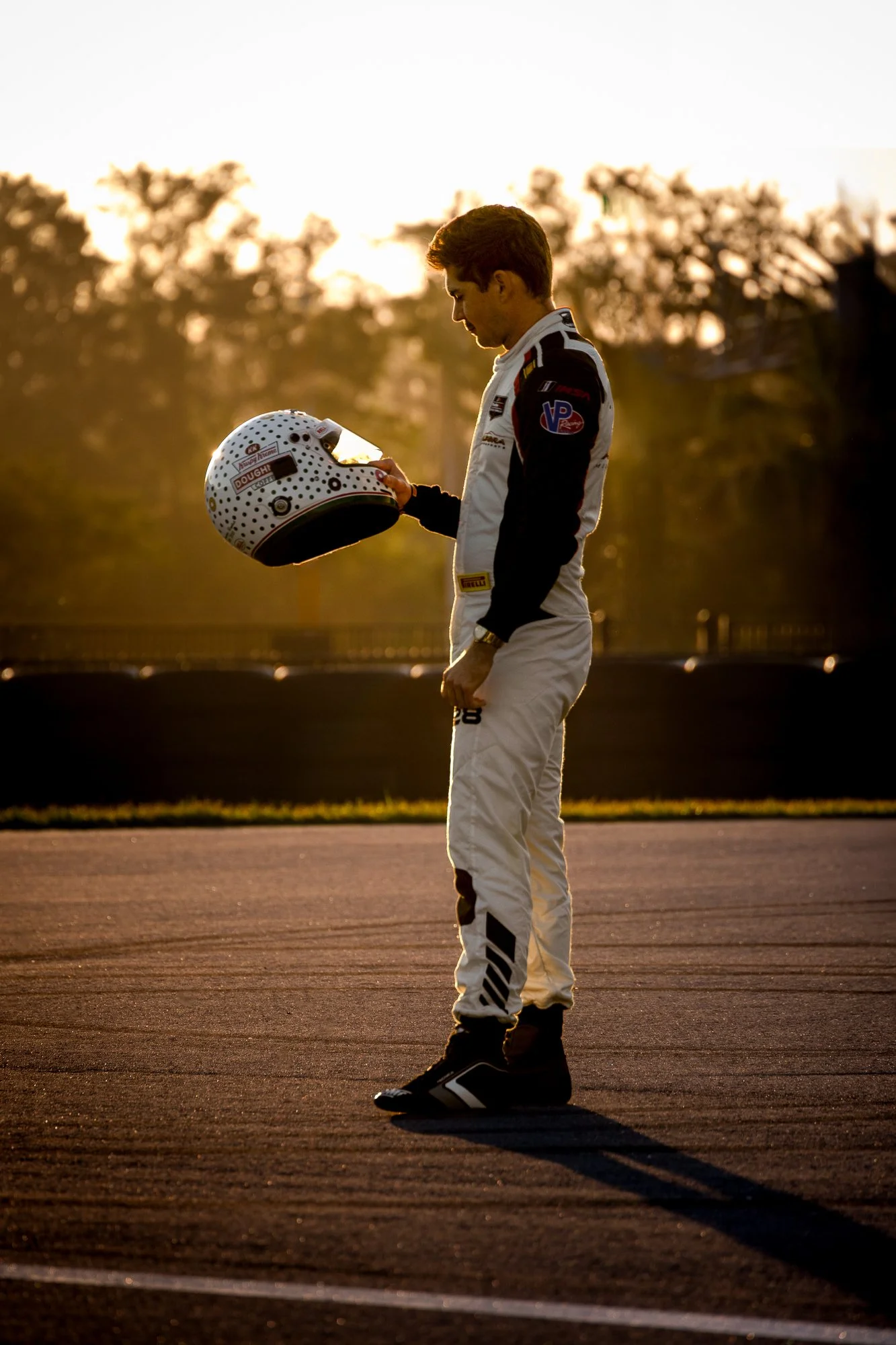
A car like this doesn't drive itself. Capturing the driver is just as critical as capturing the machine. The relationship between the two is what makes motorsport compelling. It’s a partnership built on trust, skill, and a healthy dose of adrenaline. We positioned the driver and the car on the track as the sun broke over the tree line. The long shadows and golden light provided a natural contrast to the stark, technical design of the Radical and the crisp white of the driver's suit.
The driver, standing next to the car with helmet in hand, anchors the scene. It’s a moment of quiet focus before the violence of speed takes over. You can see the anticipation in his posture—the calm before the storm. The helmet itself, dotted and detailed, adds a layer of personality to the uniform. It’s a reminder that behind the visor, there’s a human being making split-second decisions at triple-digit speeds.
We shot several variations of this setup, playing with the light and the angles. In one shot, the driver is looking out over the track, the sun catching the edge of his profile. In another, he’s adjusting his gloves, the focus entirely on the preparation. These quieter moments are often just as powerful as the high-speed action shots. They provide context and humanity to a sport that is often dominated by machinery and statistics.
The Details of Preparation
Before the car ever turns a wheel in anger, there is a meticulous process of preparation. The mechanics check the tire pressures, the suspension settings, and the fluid levels. The driver goes over the track map, visualizing the braking points and the apexes. It’s a choreographed routine that happens before every session, a necessary ritual to ensure that both car and driver are ready for the physical demands of the track.
I spent some time focusing on these details, capturing the tools of the trade. A close-up of the steering wheel, with its array of buttons and dials. A shot of the racing harness, worn and frayed from use. These images might not have the visual impact of a panning shot, but they tell a crucial part of the story. They show the reality of motorsport—the grime, the wear, and the constant pursuit of perfection.
The light during this period is shifting rapidly. The warm, golden tones are giving way to the harsher, cooler light of mid-morning. You have to adapt quickly, adjusting your exposure and your composition to match the changing conditions. It’s a constant balancing act, a dance between the available light and the technical limitations of your gear.
Speed and Focus
Once the car is moving, the challenge shifts entirely. It’s no longer about composing a static scene; it’s about conveying motion. Panning at slow shutter speeds is a game of margins. You want the background to blur into streaks of speed while keeping the car tack-sharp. It requires a steady hand, a smooth follow-through, and a lot of practice.
As the Radical tore down the straight, the Hermann Tilke-designed curves of The Motor Enclave provided the perfect backdrop. The track's modern architecture blurred into horizontal lines, emphasizing the sheer pace of the car. The American flag detail on the rear wing cut through the motion, a sharp detail in a sea of speed.
I positioned myself on the inside of a fast, sweeping right-hander. This allowed me to track the car as it approached, capturing the aggressive turn-in and the squat of the suspension as the driver applied the power. The sound of the engine bouncing off the rev limiter is deafening, a visceral reminder of the forces at play. You feel it in your chest as much as you hear it.
Shooting at these speeds means you are going to miss a lot of shots. You might get the pan perfectly smooth, but the focus is slightly off. Or the focus is sharp, but the framing is awkward. It’s a numbers game. You shoot in bursts, hoping that all the elements align for that one perfect frame. When they do, it’s incredibly satisfying. The resulting image conveys the energy and the violence of the sport in a way that a static shot simply cannot.
The Aftermath
The shoot wraps when the light gets too harsh. The golden hour burns off, replaced by the flat, unforgiving glare of mid-morning. The contrast becomes too high, the shadows too deep, and the magic of the early light is gone. But for those two hours, we had the run of the place.
We packed up our gear as the track began to wake up. Other drivers were arriving, unloading their cars and preparing for their own sessions. The quiet exclusivity of the morning was replaced by the busy energy of a track day. It’s a different vibe, but one that is equally compelling.
The Motor Enclave is a unique facility. It’s more than just a racetrack; it’s a community for those who share a passion for performance. Capturing it at sunrise, with a Radical tearing through the quiet, is a reminder of why we set the alarm in the first place. It’s about chasing the light, capturing the motion, and telling the story of the people and the machines that inhabit this world.
It’s not always glamorous. There’s a lot of waiting, a lot of failed shots, and a lot of cold mornings. But when the light is right, and the car is on the limit, and you manage to capture that fleeting moment of perfection—it makes all the early alarms and the cold asphalt worthwhile. It’s the pursuit of that one image that keeps you coming back, early morning after early morning.